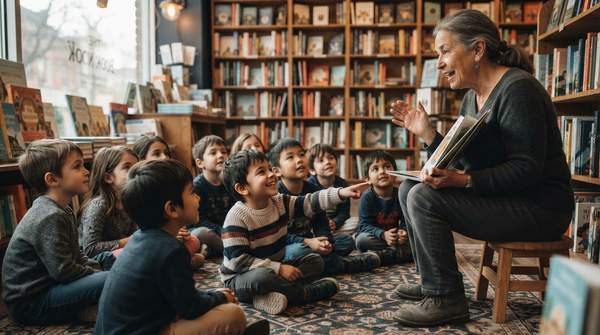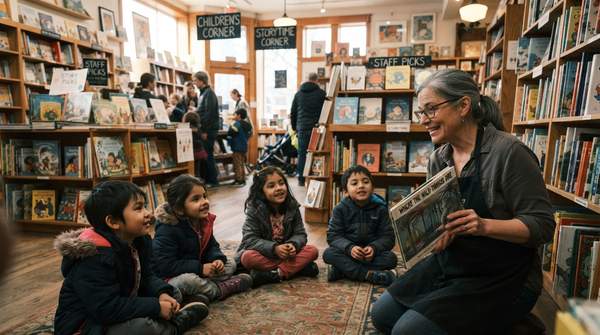
A well-curated children’s section is not a shelf of random bestsellers. Independent bookstores build their children’s offerings around staff expertise, intentional selection, and community programming—and you can judge a store’s quality by looking for observable signs of each. A Harvard Business School working paper on independent bookselling describes the shift in strategy this way: booksellers began promoting their stores as “intellectual centers for convening customers with likeminded interests,” offering lectures, signings, game nights, children’s story times, young adult reading groups, and even birthday parties. Some stores, the paper notes, routinely host more than 500 events a year.
The Intentional Art of Children’s Book Curation
What separates curation from stocking is intent. A bookstore that curates its children’s section chooses each title for a reason: because it reflects the community it serves, because it opens a door for a particular age or reading level, or because a staff member genuinely believes a child will love it. Industry guidance for independent booksellers, published by the American Booksellers Association’s trade arm, frames shopping indie as a choice with visible consequences—supporting local economies and strengthening community and culture. That framing applies to the children’s section as much as any other part of the store.
Curation is also local. The Business School analysis identifies “localism” as a defining element of independent booksellers’ strategy, meaning selections are shaped by the neighborhood and its families rather than by a national merchandising plan. In practice, this looks like a children’s area where a parent can find books tied to local authors, regional interests, or the specific questions kids in that community are asking. The store is also a physical space, and a well-designed children’s section is one a child can browse, sit in, and take ownership of.
Youth Literary Events: Fostering Literacy and Community
Events are where a bookstore’s commitment to young readers becomes visible. The Business School paper lists children’s story times and young adult reading groups among the core convening activities independent booksellers use to position themselves as community intellectual centers. Bookseller-oriented writing on youth literacy agrees about the mechanism: family engagement in reading—reading together, discussing stories, exploring new books as a family—sets the stage for lifelong literacy habits, and independent bookstores support that by hosting storytelling sessions and family events that invite everyone to participate.
The important thing for a parent or educator to understand is that these events are not interchangeable. A story time, an author visit, a workshop, and a book club each do different work. Treating a store’s event calendar as one undifferentiated offering misses what the calendar tells you about the store’s priorities and its fit for your family.