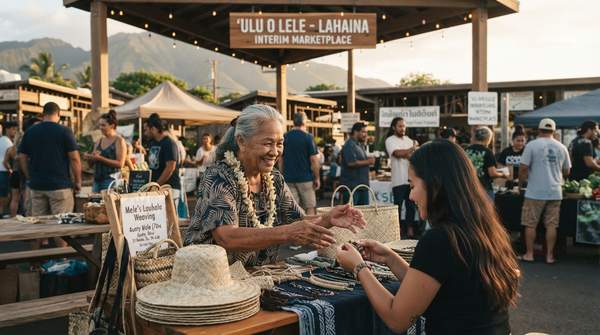
Lahaina took a concrete step out of post-wildfire displacement on Tuesday, Nov. 10, 2026, with the grand opening of ʻUlu o Lele, an interim marketplace at the former Outlets of Maui site. The County of Maui and the Hawaiian Council, with support from the Hawaiʻi Community Foundation, framed the afternoon celebration—running from 1 p.m. to 8 p.m. with festivities and a free concert by Common Kings—as more than a ribbon-cutting: a deliberate attempt to restart the town's commercial life and give residents a place to gather again.
The site is designed to do two jobs at once. It gives local businesses displaced by the Aug. 8, 2023, wildfires a physical place to reopen and earn again, and it re-establishes a central gathering space in a town whose commercial heart was destroyed. The celebration itself marked only the opening of the grounds and communal areas; individual shops will open on a rolling basis as they become ready, meaning the marketplace's full commercial footprint will take shape over the coming weeks rather than all at once.
ʻUlu o Lele: A Framework for Lahaina's Recovery
The project's design can be read as a map from specific features to specific recovery goals. Each element below is drawn from the organizers' own announcements about the marketplace's structure and purpose.
| Aspect | Design Feature | Intended Recovery Outcome |
|---|---|---|
| Grand opening event | Nov. 10, 2026, opening of the marketplace grounds and community gathering spaces, with festivities from 1 to 8 p.m. and a free Common Kings concert | A shared celebration that marks the site's availability to the public before shops are fully occupied |
| Interim location | The former Outlets of Maui site, used temporarily while Lahaina rebuilds | Local businesses can reopen and generate income without waiting for permanent reconstruction |
| Vendor selection | Selection informed by the ʻUlu o Lele Advisory Committee, with priority for businesses directly affected by the 2023 wildfires or with a Lahaina connection | Recovery resources flow first to the businesses and families the wildfires hit hardest |
| Staggered openings | Individual shops open as they are ready; some may open after the celebration | Flexibility for owners rebuilding operations at different speeds |
| Community programming | A place to shop, eat, gather, and connect, bringing businesses, entrepreneurs, artisans, and community services back into the heart of Lahaina | Supports local jobs while reflecting the people, culture, and character of Lahaina |
The framework shows why the marketplace is described as an interim project rather than a finished recovery: its purpose is to bridge the gap between displacement and permanent rebuilding. By prioritizing wildfire-affected vendors, the organizers aim to direct the site's economic activity toward those who lost the most, while the shared grounds are meant to restore some of the everyday social life—a place to eat, listen to music, and reconnect with neighbors—that the fire removed from the town.
A Two-Pronged Strategy: Economic Incubator and Community Hub
As an economic instrument, ʻUlu o Lele functions as an incubator. Businesses that lost physical locations in the fires gain a ready-made commercial address in the heart of Lahaina, along with foot traffic drawn by the site's events and concentration of vendors. The organizers state the goal plainly: bringing local businesses, entrepreneurs, and artisans back into Lahaina supports local jobs and business income during the years that permanent reconstruction will take.
As a civic instrument, the marketplace is meant to be a hub. The grand opening invitation asked residents to bring their families, enjoy the music, and reconnect with friends and neighbors—an explicit acknowledgment that what was lost in the fires was not only commerce but the social texture of a town. The site's own description, as a place to shop, eat, gather, and connect while reflecting Lahaina's people, culture, and character, positions it as a stand-in for gathering spaces that no longer exist elsewhere in the district.
The dual role matters because the two goals reinforce each other. Foot traffic drawn by events and community use becomes customers for the vendors, and the presence of operating local businesses gives residents a reason to return to a part of town that has had little to offer since the disaster.
Local Businesses Find a New Home: Stories of Resilience and Hope
The marketplace's abstract strategy becomes concrete in the stories of the vendors moving in. Smash Maui, a locally owned food truck and catering business, had operated near Maria Lanakila Church in Lahaina. Its truck was destroyed in the wildfires just four months after the business opened—a loss of a significant investment and of the business's chance to establish itself. Through ʻUlu o Lele, the owner hopes to return to serving Lahaina families, reconnect with customers, and help restore the familiarity that local food businesses bring to a community.
Ono Tacos Lahaina Mexican Food, which serves tacos, burritos, and quesabirrias, is also returning through the marketplace. Its owner lost his home and experienced significant business losses in the wildfires; his former workplace, a tattoo shop, was destroyed and has not reopened. Via ʻUlu o Lele, the business intends to foster opportunities for local artists and apprentices, draw customers to adjacent businesses, and establish a creative gathering spot that supports community connection and recovery.
Hawaiʻi Gelato lost both its retail location and its production kitchen to the fire. The business hopes to reopen at the marketplace to continue offering Italian-style gelato and dairy-free sorbetto. Other vendors profiled ahead of the opening include Goin Left, a surf lifestyle boutique established in Lahaina in 2015 offering handcrafted surfboards, fins, locally made artwork, clothing, and swimwear; West Side Boba, a food truck specializing in handcrafted boba drinks, fruit and milk teas, specialty shakes, and Filipino-inspired beverages, whose owners were displaced from their Lahaina home during the wildfires; and a barbershop business that aims through the marketplace to create local jobs, provide apprenticeship opportunities for affected barbers, and establish a welcoming space where residents can reconnect.
These profiles share a pattern: owners who lost homes, equipment, or commercial space in the fires are using the marketplace to regain a Lahaina foothold, and several explicitly describe goals that extend beyond their own revenue—apprenticeships, foot traffic for neighboring shops, and spaces where residents can meet again.
Moving Forward: Monitoring Lahaina's Economic Pulse
Lahaina residents and stakeholders can monitor the progress of the ʻUlu o Lele marketplace as a key indicator of the town's economic and community recovery. The concrete signals to watch are the ongoing opening of individual shops within the marketplace as vendors become ready, and the sustained foot traffic and community engagement at the site in the months after the Nov. 10 celebration. Event updates and vendor information are being posted at uluolele.com as the marketplace fills in.
What the opening cannot yet show is the project's longer-term effect. The marketplace is explicitly interim, and the milestone that would mark Lahaina's true commercial recovery—the permanent rebuilding of the town's commercial district—remains ahead. Until then, ʻUlu o Lele serves as the most visible test of whether Lahaina's displaced entrepreneurs can re-establish themselves, and whether residents will return, shop, and gather in a part of town that the fires emptied.
Sources
- ʻUlu o Lele grand opening celebrates Lahaina businesses and community — | ʻUlu o Lele grand opening celebrates Lahaina businesses and community
- ʻUlu o Lele
- News: Grand opening of ‘Ulu o Lele in Lahaina set for Nov. 10 — Mauirecovers